Listen


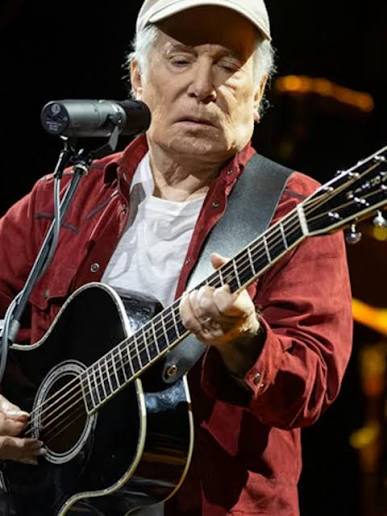
Paul Simon stands as one of the most literate, musically adventurous songwriters in modern popular music, bridging folk-rock, pop, and global rhythms across a career spanning more than six decades.
Family, Childhood, and Schooling
Paul Frederic Simon was born on October 13, 1941, in Newark, New Jersey, to Jewish Hungarian parents, Louis and Bella Simon. Shortly after his birth, the family moved to the Kew Gardens Hills neighborhood of Queens, New York City, where Paul grew up alongside his younger brother, Eddie (born four years later), who went on to become a guitar teacher and music educator.
Music and education were woven into the fabric of the Simon household from the start. His mother, Bella, was an elementary school teacher, while his father, Louis, was a college professor who also worked professionally as a double bassist and dance bandleader under the stage name "Lee Sims." Paul frequently accompanied his father to gigs, absorbing big band, swing, and jazz long before rock and roll existed.
Simon attended Public School 164 in Queens. In the fourth grade, watching his classmate Art Garfunkel sing Nat King Cole's "Too Young" at a school talent show sparked Paul's desire to sing. The two became close friends at age 11 while rehearsing together for a sixth-grade graduation production of Alice in Wonderland, with Paul playing the White Rabbit and Art playing the Cheshire Cat.
Both boys attended Forest Hills High School. After graduating, Simon majored in English literature at Queens College, graduating in 1963. Bowing briefly to family pressure for a practical backup plan, he enrolled at Brooklyn Law School, though he dropped out after a single semester to pursue music full-time.
Musical Beginnings: From "Tom & Jerry" to Folk Clubs
By age 13, Simon and Garfunkel were singing harmonies at school dances, heavily inspired by the Everly Brothers and early doo-wop. At 15, they wrote and recorded "Hey, Schoolgirl." Signed to Big Records and rebranded by the label as Tom & Jerry, the teenage duo scored a minor hit in 1957 when the single reached number 49 on the Billboard pop charts, even landing them an appearance on American Bandstand.
Follow-up singles stalled, and the pair drifted apart during college. Between 1957 and 1964, Simon worked tirelessly behind the scenes in New York's Brill Building music scene. He wrote, produced, and recorded over 30 tracks under various pseudonyms—including Jerry Landis, Paul Kane, and True Taylor—and briefly fronted a group called Tico & The Triumphs, nudging the lower reaches of the charts with "Motorcycle" (1962) and "The Lone Teen Ranger" (1962).
Rise to Fame with Simon & Garfunkel
By 1963, Simon had pivoted toward the Greenwich Village folk revival, blending acoustic introspection with social commentary. Reuniting with Garfunkel under their real names, they released their acoustic debut album, Wednesday Morning, 3 A.M., in October 1964. It sold poorly, prompting Simon to move to England, where he honed his craft performing in folk clubs and recorded a solo acoustic album, The Paul Simon Songbook (1965).
While Simon was abroad, producer Tom Wilson took an acoustic track from their debut album—"The Sound of Silence"—and overdubbed electric guitars, bass, and drums without the duo's knowledge. Released in late 1965, the newly electrified track rocketed to number one in the United States in January 1966, pioneering the folk-rock sound and bringing Simon rushing back to New York.
Over the next four years, Simon & Garfunkel became one of the defining musical acts of the 1960s. Their music anchored Mike Nichols's landmark 1967 film The Graduate, propelling "Mrs. Robinson" to number one. Albums like Parsley, Sage, Rosemary and Thyme (1966) and Bookends (1968) showcased Simon's increasingly poetic, literary lyrics paired with Garfunkel's soaring tenor. Their fifth and final studio album, Bridge over Troubled Water (1970), became a global phenomenon, winning six Grammy Awards—including Album of the Year and Record of the Year—just as creative and personal friction led the duo to part ways.
Solo Reinvention and Global Sounds
Rather than coasting on folk-rock nostalgia, Simon built an acclaimed solo career defined by restless musical curiosity. His self-titled 1972 solo album introduced reggae rhythms on "Mother and Child Reunion" (recorded in Kingston, Jamaica) and Latin folk textures on "Me and Julio Down by the Schoolyard." He followed with There Goes Rhymin' Simon (1973) and Still Crazy After All These Years (1975), which won him his second Album of the Year Grammy.
After a commercial slump in the early 1980s, Simon traveled to Johannesburg to collaborate with South African township musicians, including Ladysmith Black Mambazo. Blending mbaqanga rhythms with sharp American storytelling, Graceland (1986) sold over 16 million copies, won Album of the Year at the Grammys, and introduced world music to a massive mainstream audience.
He continued pushing boundaries with Brazilian percussion on The Rhythm of the Saints (1990) and earned renewed acclaim in his seventies with albums like So Beautiful or So What (2011) and Stranger to Stranger (2016).
Signature Hits
With Simon & Garfunkel: "The Sound of Silence" (1965), "Homeward Bound" (1966), "I Am a Rock" (1966), "Scarborough Fair/Canticle" (1966), "Mrs. Robinson" (1968), "America" (1968), "The Boxer" (1969), "Bridge over Troubled Water" (1970), and "Cecilia" (1970).
As a Solo Artist: "Mother and Child Reunion" (1972), "Me and Julio Down by the Schoolyard" (1972), "Kodachrome" (1973), "Loves Me Like a Rock" (1973), "50 Ways to Leave Your Lover" (1975), "Still Crazy After All These Years" (1975), "Slip Slidin' Away" (1977), "You Can Call Me Al" (1986), and "Graceland" (1986).
Across his career, Paul Simon has earned 16 Grammy Awards (including a Lifetime Achievement Award), been inducted twice into the Rock and Roll Hall of Fame—both with Simon & Garfunkel and as a solo artist—and cemented his reputation as a master chronicler of modern life.